As my research progressed I became increasingly aware that communication and intelligence where it exists in plants is not likely to just be the result of electrical or chemical signalling but may include many other forms of signaling as well. Also research I was reading was breaking down the barrier I had in my mind between the animal and plant kingdoms. For example bees and flowers are now known to exchange information via electrical signalling and there are countless other examples of animal and plant communication. This installation explored the idea of the forest being a giant signalling network or a kind of fax machine in which information is shared through a network via electrical, chemical, sonic and even mechanical means (animals), the implication being this forms some kind of greater whole in much the same ways cells and signalling function in our body . I wanted to make the complexity of this audio signaling more apparent to the listener, to bring attention to the organized sonic minutiae that might otherwise have been lost in a wall of sound. Entire soundscapes could be found within the briefest fleck of noise which naturally occurred outside the range of human hearing, and it is these details that I wished to use as the building blocks for the compositions. I also aimed to increase awareness of the complexity of a forest signalling system and how little we understand it by opening ourselves to the possibility of diverse forms of signalling. It is possible to consider the whole ecosystem, including animals and birds, as part of one highly complex signalling system.
Aesthetically “The Code” was much darker than the next two installations. The installation was visually less convincing than the other two. It was in a garden in the center of a large modern building. As was the case with all of the installations, this was to some extent a live performance over three days as well. I was constantly interacting with and responding to the sounds as they were produced by changing parameters as the soundscape evolved. In addition to modifying samples some samples were triggered by action potentials. These samples would emanate from the location of the signals but then proceed to ‘spread’ outwards, like ripples in a pond. This was achieved using delay lines and automation.
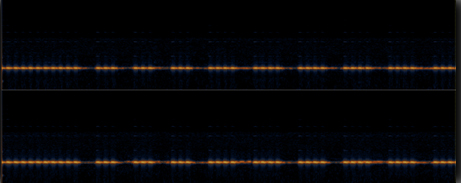
The pulses of these calls are organized into discrete packets, each of which contained varying numbers of pulses (fig. 13). These sequences of pulses appear so complex and varied that it is hard not to speculate that they form a kind of syntax and communication beyond mere reproductive or territorial signaling.
Cricket and insect sounds when isolated exhibit Morse-like discrete sequences of pulses. The Morse-like sounds were isolated and formed the core of the soundsources in the installation “The Code” in Brazil. Sounds : “cricket code” and composition “The Code”
Update RequiredTo play the media you will need to either update your browser to a recent version or update your
Flash plugin.
Update RequiredTo play the media you will need to either update your browser to a recent version or update your
Flash plugin.